The Art of Democracy: War and Empire at Meridian Gallery
Curated by Anne Brodzky, DeWitt Cheng, and Art Hazelwood
September 4- November 4, 2008
Opening reception: Thursday September 4, 6-9 PM
![]() |
||||
|
|
||||
|
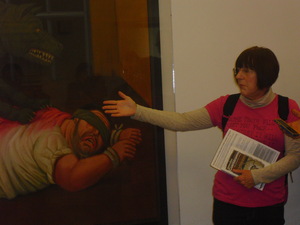
(c) Fernando Botero, Abu Ghraib 72, 2005
Collection of American University Museum, Washington DC | ||||
Thinking globally
According to Peter Selz, art historian and author of Art of Engagement: Visual Politics in California and Beyond, "Not since the 1930s, facing the Great Depression and the impending danger of a Fascist New World Order, and the 60s with a previous illegal and immoral war, has there been such a great outpouring of political art. At the present, a great many artists, working in media, old and new, have again picked up their brushes, cameras or computers to protest against a foul war, destruction of the environment, obscene fiscal gains and abnegation of constitutional rights to express their rage and speak to the public."
Artists across the country, animated by response to events of the last seven years and mobilized over the past two years by Art Hazelwood, a San Francisco-based printmaker, and Stephen A. Fredericks, president of the New York, Society of Etchers have organized a series of forty exhibitions entitled Art of Democracy. The exhibitions, spanning the United States from Washington State to New Hampshire, including Puerto Rico, will analyze what went wrong within this millennium with an America that was admired not so long ago.
But the organizers of these shows hope to do more than simply indict the malefactors of great wealth; they hope to help inspire a new public spirit. The novelist Richard Flanagan, writing in Bookforum, sees the role of the artist in time of crisis as moral and humanistic, not merely esthetic: "There are so many forces in the world that divide us deeply and murderously. In recent times, we have lived through not so much a crisis of politics as a collapse of that most human attribute, empathy, a collapse so catastrophic it sometimes appears to be a crisis of love...." Art offers an alternative vision, however, Flanagan concludes: "At its best, art reminds us of all we share, of all that brings us together."
San Francisco's non-profit Meridian Gallery will host the most comprehensive of the Bay Area shows, Art of Democracy: War and Empire, from September 4 to November 4. Each national exhibition and event has its own sub theme; Meridian Gallery chose War and Empire. In addition to the exhibition featuring more than forty artists, an extensive schedule of related films, concerts, and lectures is conceived as an integral component of the show.
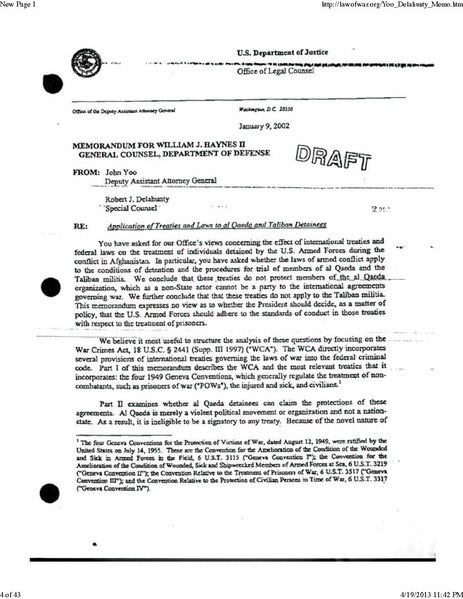
'Hamdan v. Rumsfeld': The Landmark Case & Impact on Guantánamo Detainees
9/16/2008 6:00 PM - 7:00 PM Please arrive early for registration
World Affairs Council Auditorium
312 Sutter Street
Second Floor
San Francisco, California 94108
The trial before a special military tribunal of Salim Ahmed Hamdan, a former driver of Osama bin Laden, is the first US war crimes tribunal since World War II. Beyond serving as the opening of the controversial tribunals, Hamdan's detention and case have been at the center of one of the Supreme Court's most significant decisions on presidential power and the rule of law. Jonathan Mahler joins the Council to discuss Hamdan v. Rumsfeld, the legality of the tribunals at Guantánamo Bay, and the battle over presidential power.
This event is co-sponsored by the Human Rights Center at UC Berkeley, Human Rights Watch, International Development Exchange, and the San Francisco Bar Association.
Advanced registration is recommended for guaranteed seating. However, pre-registration is not required and walk-ins on the day of this program are welcome.
To begin the registration process please select one of the following fees.
| Description | Amount | |
| Member |
Free | Register fee ends 9/16/2008 |
| Non-member |
$15.00 | Register fee ends 9/16/2008 |
| Student with valid ID |
$5.00 | Register fee ends 9/16/2008 |
| Co-sponsor |
$7.00 | Register fee ends 9/16/2008 |
| Ticket + Membership |
$95.00 |
Register
|
Wednesday, September 17 | 4:10 p.m. | Lipman Room, 8th floor Barrows Hall
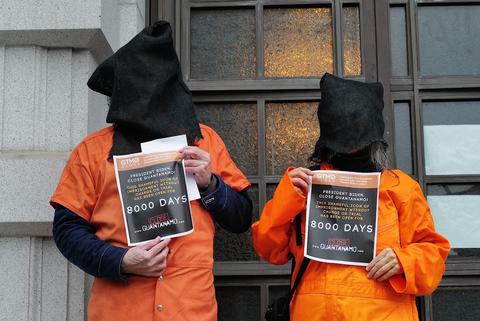
In the weeks following the terrorist attacks of September 11, 2001, the Bush administration made the fateful decision to house "enemy combatants" captured in the war against the Taliban at the U.S. Naval base at Guantanamo Bay, Cuba -- out of reach, the administration believed, of the ordinary civilian and military justice systems. Three times over nearly seven years, the Supreme Court pushed back and told the President that he had made the wrong call. Yet in all those years, not a single detainee has been ordered released, against the government's will, by the authority of any institution. That is the mystery of Guantanamo Bay which Pulitzer Prize-winning journalist, Linda Greenhouse, will explore in this lecture, part of UC Berkeley's observance of Constitution Day.
Townsend Center for the Humanities, 220 Stephens Hall